
2026-04-08
- Athlete: Sidney McGill
- Username: sidney
- Timezone: America/Edmonton
- Last updated: 2026-04-13 consolidation migration
Summary
Consolidated daily log created from legacy Coach Luca records.
Activities
- No confirmed athlete activity consolidated for this date.
Coach Luca
- No coordinator synthesis consolidated for this date.
Endurance
Heartbeat
- Daily endurance log created during heartbeat check.
- Race schedule remains placeholder-only as of 2026-04-06.
- Goals and priority events remain incomplete.
- No race-specific update is available to change session specificity.
Risks / Flags
- Stale-assumption risk: any event-specific training prescription would be based on unsupported assumptions.
- Load-distortion risk: without confirmed target events, specificity and progression can drift away from actual demands.
Current stance
- Keep recommendations general until planning inputs are populated.
- Protect freshness as much as load.
- Escalate to Coach Luca when a training decision depends on event specificity.
Recovery
- Agent: recovery
- Owner: recovery
- Related planning inputs reviewed: goals, race schedule, travel schedule
Key Observations
- Today's recovery log was created during heartbeat upkeep.
- Planning inputs reviewed with no new athlete-specific travel, race, or goal updates documented.
- No new recovery-status, sleep, readiness, or fatigue data were added in the reviewed inputs.
Recovery Risk Review
- No new travel or schedule change is present that alters current recovery risk.
- No new fatigue or readiness issue was identified from today's reviewed inputs.
Handover For Coach Luca
- No new recovery action required from this heartbeat review.
Strength
McGill - strength block recommendation (2026-04-11 to 2026-04-30)
Context
- One re-entry week completed after post-Worlds time off.
- Current riding has been mostly endurance.
- Sprained ankle from India travel is improving but not fully resolved.
- Goal for this 3-week block: re-establish meaningful strength exposure without compromising ride quality or aggravating the ankle.
- Planning inputs are still incomplete for event and travel specifics, so gym load should stay conservative and adaptable.
Block objective
- Rebuild general strength rhythm.
- Restore lower-leg/ankle capacity and confidence.
- Maintain trunk/hip force qualities relevant to cyclocross.
- Keep soreness and neuromuscular fatigue low enough that quality riding stays intact.
Guardrails
- No heavy bilateral squat pattern if ankle dorsiflexion, landing tolerance, or pain is still limited.
- No plyometric or high-rate change-of-direction work until ankle is pain-free, swelling is settled, and single-leg hopping is clearly tolerated.
- Keep lower-body work at 2-4 reps in reserve for first 2 weeks.
- If ankle pain rises above mild during or after session, regress range/load and remove unilateral instability demand first.
- Place gym after easier endurance days or later on the same day as non-key rides, never before key intensity.
Weekly structure
- 2 gym sessions per week across all 3 weeks.
- 2 short ankle/foot mobility-capacity micro-sessions per week.
- Optional 10-12 min activation before hard bike days if tolerated.
Session placement
- Ideal: Tue/Fri or Mon/Thu.
- At least 48 h between gym sessions when possible.
- Avoid heavy lower-body work within 24 h before key bike intensity.
Week 1 (Apr 11-17) - re-load, protect ankle
Frequency:
- 2 gym sessions
- 2 ankle micro-sessions
Session A
- Trap-bar deadlift from high handles or blocks: 3 x 5 @ RPE 6-7
- Rear-foot-elevated split squat isometric hold OR split squat short ROM if tolerated: 3 x 20-30 s/side or 3 x 6/side
- DB bench press: 3 x 6-8 @ RPE 7
- Chest-supported row: 3 x 8
- Half-kneeling Pallof press: 3 x 8/side
- Seated calf raise (slow): 3 x 10-12
- Tibialis raises: 2-3 x 12-15
Session B
- Goblet box squat to comfortable depth: 3 x 6 @ RPE 6
- Romanian deadlift: 3 x 6 @ RPE 6-7
- Step-up to low box, controlled: 2-3 x 6/side if ankle tolerates; otherwise substitute leg press short ROM
- Pull-up or assisted pull-up / lat pulldown: 3 x 6-8
- 1-arm cable row or DB row: 3 x 8/side
- Side plank with top-leg abduction or standard side plank: 2-3 x 20-30 s/side
- Standing calf isometric mid-range: 3 x 30-45 s
Ankle micro-session menu (10-15 min)
- Knee-to-wall dorsiflexion mobilization: 2 x 8-10
- Banded talocrural mobilization if helpful: 1-2 min
- Single-leg balance barefoot or in flat shoe: 3 x 20-30 s/side
- Eccentric calf lower off step or floor: 2-3 x 8
- Band inversion/eversion: 2 x 12-15 each
- Short-foot drill: 2 x 5 breaths
Week 2 (Apr 18-24) - build slightly if ankle response is good
Progress only if no next-day increase in pain/swelling and riding quality is unaffected.
Session A
- Trap-bar deadlift: 4 x 4-5 @ RPE 7
- Split squat short ROM or RFESS: 3 x 6/side
- DB bench press: 3 x 6-8
- Chest-supported row: 3 x 8
- Pallof press with step-out: 3 x 8/side
- Seated calf raise: 3 x 8-10, slightly heavier
- Tibialis raises: 3 x 12-15
Session B
- Front-foot-elevated split squat or goblet squat: 3 x 6/side or 3 x 5
- Romanian deadlift: 3-4 x 5-6 @ RPE 7
- Step-up: 3 x 6/side, moderate load, only if push-off is pain-free
- Pull-up/pulldown: 3 x 6-8
- 1-arm row: 3 x 8/side
- Anti-rotation lift/chop: 2-3 x 8/side
- Standing calf isometric or bent-knee soleus raise: 3 x 30 s or 3 x 10
Ankle progression options
- Add controlled lateral step-downs 2 x 5/side
- Progress single-leg balance to eyes closed or reach pattern
- Introduce low pogo prep only if fully pain-free: bilateral line hops in place 2 x 10 contacts
Week 3 (Apr 25-30) - consolidate, do not chase fatigue
Keep the same 2-session structure. Increase load modestly or add one set only if prior 2 weeks were clean.
Session A
- Trap-bar deadlift: 4 x 4 @ RPE 7-7.5
- Split squat or RFESS: 3 x 5/side @ controlled tempo
- DB bench press: 3 x 5-6
- Chest-supported row: 3 x 6-8
- Pallof press: 3 x 8/side
- Seated calf raise: 3 x 8
Session B
- Goblet squat / safety-bar squat to tolerated depth if available: 3 x 5 @ RPE 6-7
- Romanian deadlift: 3 x 5 @ RPE 7
- Step-up or leg press: 3 x 5-6/side
- Pull-up/pulldown: 3 x 6
- Side plank variation: 2-3 rounds
- Soleus/calf accessory: 2-3 sets
If ankle is clearly resolved by end of week 3
- Can begin discussing return to low-volume elastic work next block: pogos, snap-down to stick, low-amplitude skipping.
- Not needed in this block unless fully symptom-free.
Loading guidance
- Main lifts: start around RPE 6-7, finish block no higher than 7.5.
- Accessories: leave 2-3 reps in reserve.
- No grinding reps.
- Use tempo and pauses before load jumps.
- Progression rule: increase load 2.5-5% only after pain-free session and stable next-day ankle response.
Warm-up template (8-12 min)
- 3-5 min easy bike or brisk walk
- Ankle rocks and knee-to-wall x 8/side
- Glute bridge x 8
- Bodyweight split squat ISO x 20 s/side
- Dead bug x 6/side
- 2-3 progressive warm-up sets for first lift
Bike interference management
- If key ride quality drops, remove one lower-body accessory before reducing main lift exposure.
- If cumulative fatigue is high, keep session to 4-5 exercises and preserve hinge + trunk + lower-leg work.
- If ankle is irritable after riding, replace split-squat/step-up pattern with bilateral hinge plus isometrics.
Stop/regress triggers
- Increase in swelling, limping, or pain > mild during session.
- Inability to tolerate single-leg stance or step-up mechanics.
- Persistent soreness that interferes with riding for >24 h.
Internal summary for Coach Luca
- Recommend 2 controlled gym exposures/week, not 3.
- Main emphasis: hinge, controlled single-leg strength, trunk, calf-soleus-tibialis restoration.
- Keep total lower-body dose modest and position sessions away from key bike work.
- Delay true plyometrics and unstable/aggressive ankle loading until symptom-free and confident.
Nutrition
Key observations
- Intake pattern shifted quickly from a very small date-only item to a much more substantial mixed smoothie later in the morning.
- The smoothie meaningfully improves carbohydrate, protein, and overall energy intake for the day, though it is still relatively fat-heavy for close-in pre-session fueling.
- The later iced black coffee adds caffeine and some fluid but no meaningful energy, so it does not materially improve fueling coverage unless paired with separate carbohydrate intake.
- Dinner appears more balanced than several earlier items, with better overall carbohydrate coverage and at least moderate protein from lentils, tofu, and hummus.
Recommendations
- If training follows soon after the smoothie, allow enough digestion time or use a lower-fat carb source next time when rapid gut comfort matters.
- If the iced coffee is being used as a pre-session stimulant, pair it with carbohydrate when session demand is moderate to high rather than relying on caffeine alone.
- If the smoothie was taken after training, recovery coverage is materially better than the earlier date-only intake because this feeding now clearly contributes both meaningful carbohydrate and adequate protein.
- The dinner choice looks supportive overall; hummus clarification does not materially change the estimate, and if tomorrow morning includes an early demanding session, breakfast should still top up carbohydrate again rather than relying on tonight's lentil-and-bread meal alone.
Watch items
- Keep Received and Consumed timing separate whenever later athlete context changes the default assumption.
- Watch whether higher-fat smoothies are being used close to key sessions, because they can be nutritious without being the best immediate pre-hard-session format.
- Keep an eye on later-day caffeine timing if more coffee is added, so sleep and overnight recovery are not unnecessarily compromised.
- Note that higher-fiber dinners like lentils, hummus, and seeded gluten-free bread may be perfectly fine, but they are worth watching if gut comfort becomes an issue before early training.
Open questions
- None today.
Summary
11:28
- Received: 2026-04-08 11:28 MDT
- Consumed: assumed 2026-04-08 11:28 MDT (defaulted to receipt time; no athlete-stated timing provided)
- Item: one large date held in hand
- Source media path: /athlete/logs/media/2026-04-08/01-sidney-date.jpg
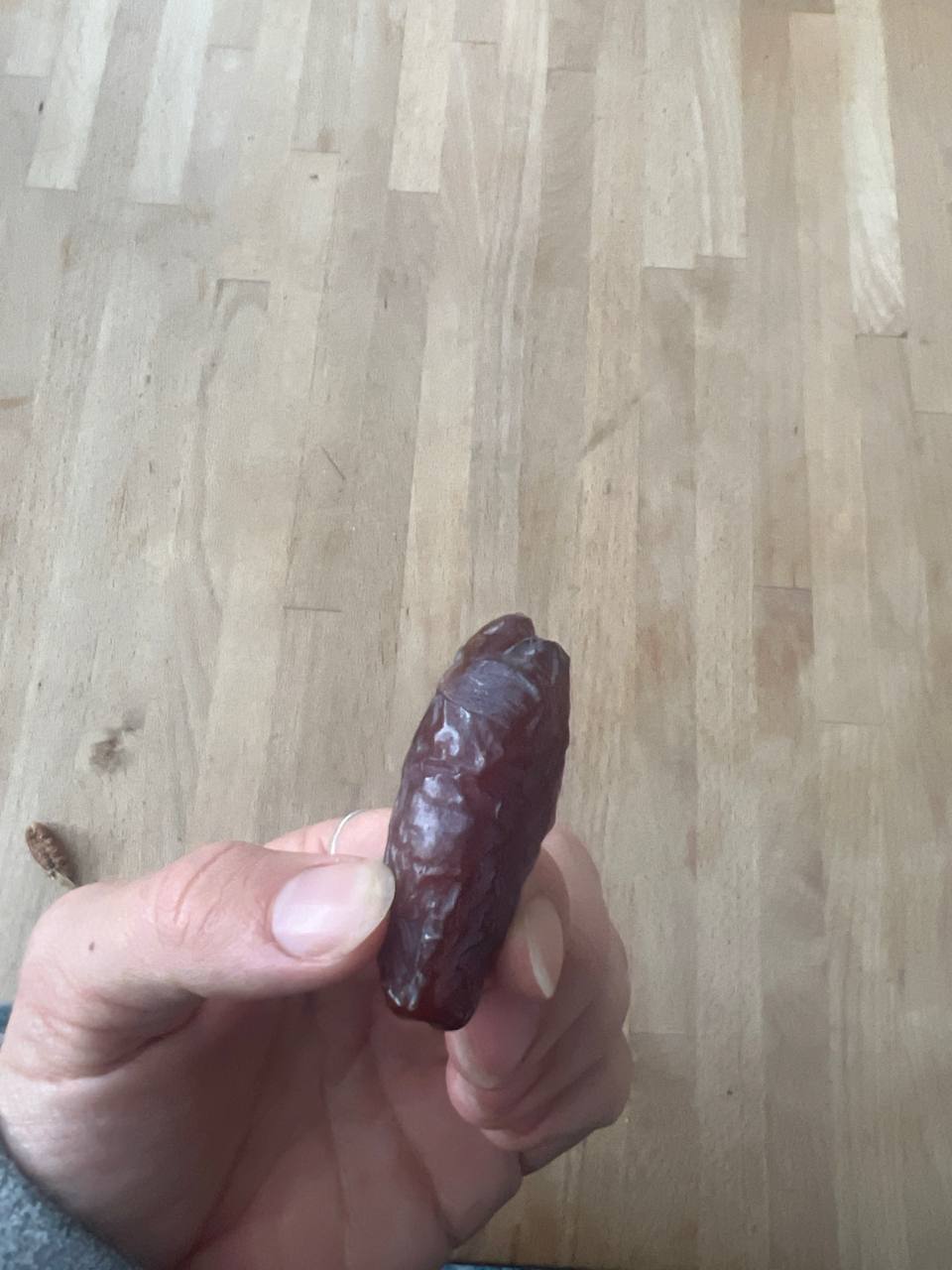
- Estimated intake: Energy 50-80 kcal; carbohydrate 13-20 g; protein 0-1 g; fat 0 g
- Key assumptions: Estimate assumes one large Medjool-sized or similarly large date based on hand scale and appearance; Pit status is unknown, but edible portion is assumed to be the typical flesh from one date; No additional foods or drinks are included in the estimate; Estimate is kept broad because exact variety and size cannot be confirmed from the image alone
- Practical implication: Fine as a small quick-carb bite or top-up, especially shortly before training or alongside other carbohydrate sources; On its own this is too small to count as meaningful pre-session fueling or post-session recovery; If this was used around training, it likely needs to sit inside a larger carbohydrate plan rather than be treated as the full snack
- Status: complete
11:47
- Received: 2026-04-08 11:47 MDT
- Consumed: assumed 2026-04-08 11:47 MDT (defaulted to receipt time; no athlete-stated timing provided)
- Item: smoothie in glass
- Source media path: /athlete/logs/media/2026-04-08/02-sidney-coffee-date-banana-smoothie.jpg
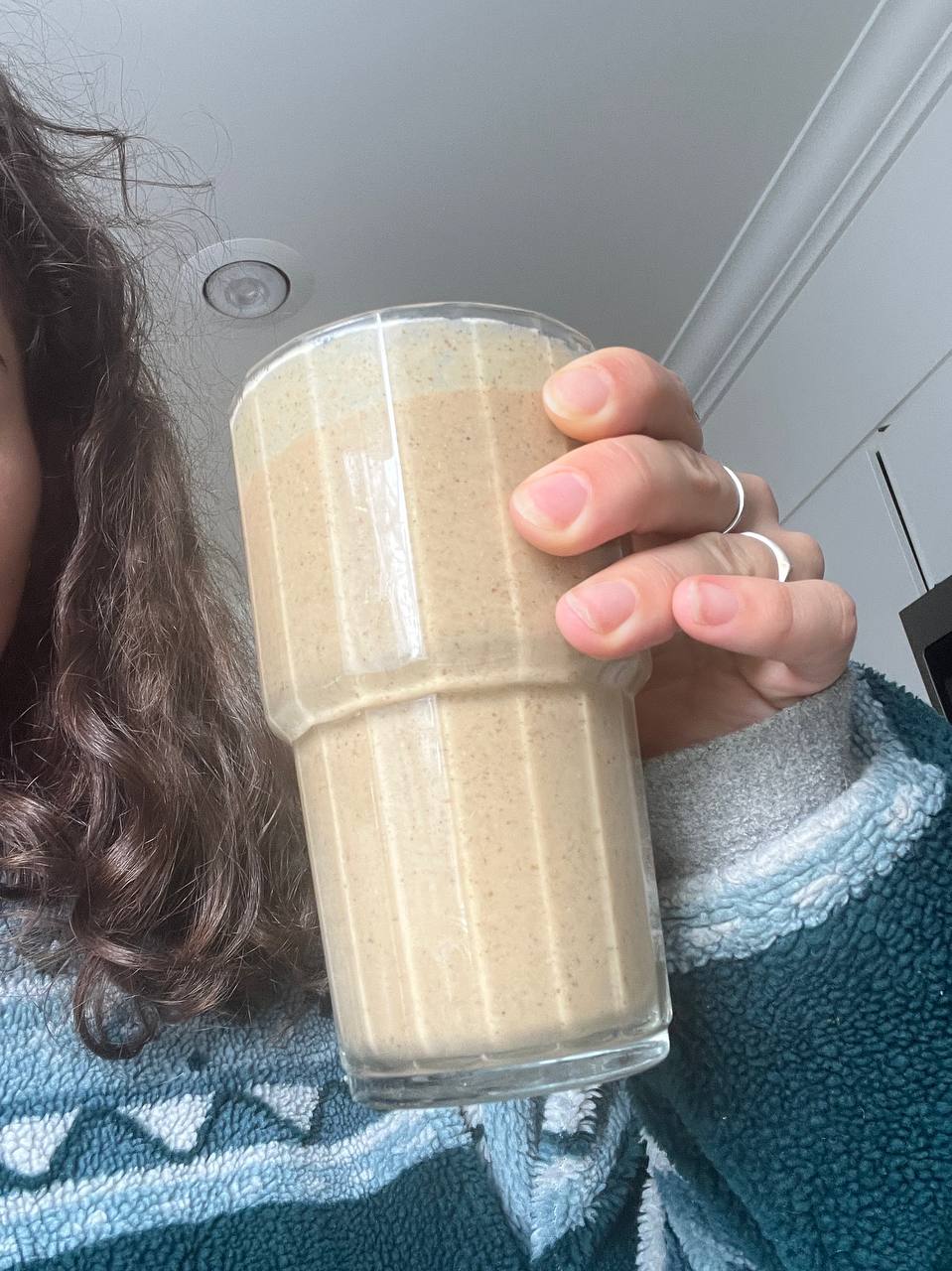
- Estimated intake: Energy 540-680 kcal; carbohydrate 80-100 g; protein 26-30 g; fat 24-29 g
- Key assumptions: Estimate is anchored primarily to the athlete-provided ingredient list rather than the photo volume; Protein powder now uses the actual label values for 1/2 scoop: approximately 85 kcal, 1.75 g fat, 2 g carbohydrate, 15 g protein, and 150 mg sodium; Dates are still the main source of uncertainty and are treated as large dates unless clarified otherwise; smaller date varieties would push the total toward the lower end of the range; Peanut butter is assumed to be 2 level tablespoons total, and 6 almonds are treated as a small garnish-sized addition; Black coffee contributes negligible calories but meaningful caffeine; Estimate is materially tighter now that the powder label is available; remaining spread is mostly due to date size and exact spooning of peanut butter and chia
- Practical implication: This is now clearly a substantial smoothie rather than a light snack: carbohydrate is meaningful, protein is adequate for a recovery feeding, and total energy is fairly high; Fat load from peanut butter, chia, and almonds remains moderate to high, so this is better with some lead time before harder training than as a last-minute pre-session option; If taken after training, the combination of carbohydrate plus about 26-30 g protein is supportive for recovery, though the slower digestion from the fat content may make a simpler option preferable when very rapid refueling is needed; Caffeine plus a large carbohydrate load makes it workable before training when there is enough time to digest it, but not ideal immediately before high-intensity work
- Status: complete
13:39
- Received: 2026-04-08 13:39 MDT
- Consumed: assumed 2026-04-08 13:39 MDT (defaulted to receipt time; no athlete-stated timing provided)
- Item: iced black coffee in mug with straw and ice
- Source media path: /athlete/logs/media/2026-04-08/04-sidney-iced-black-coffee.jpg
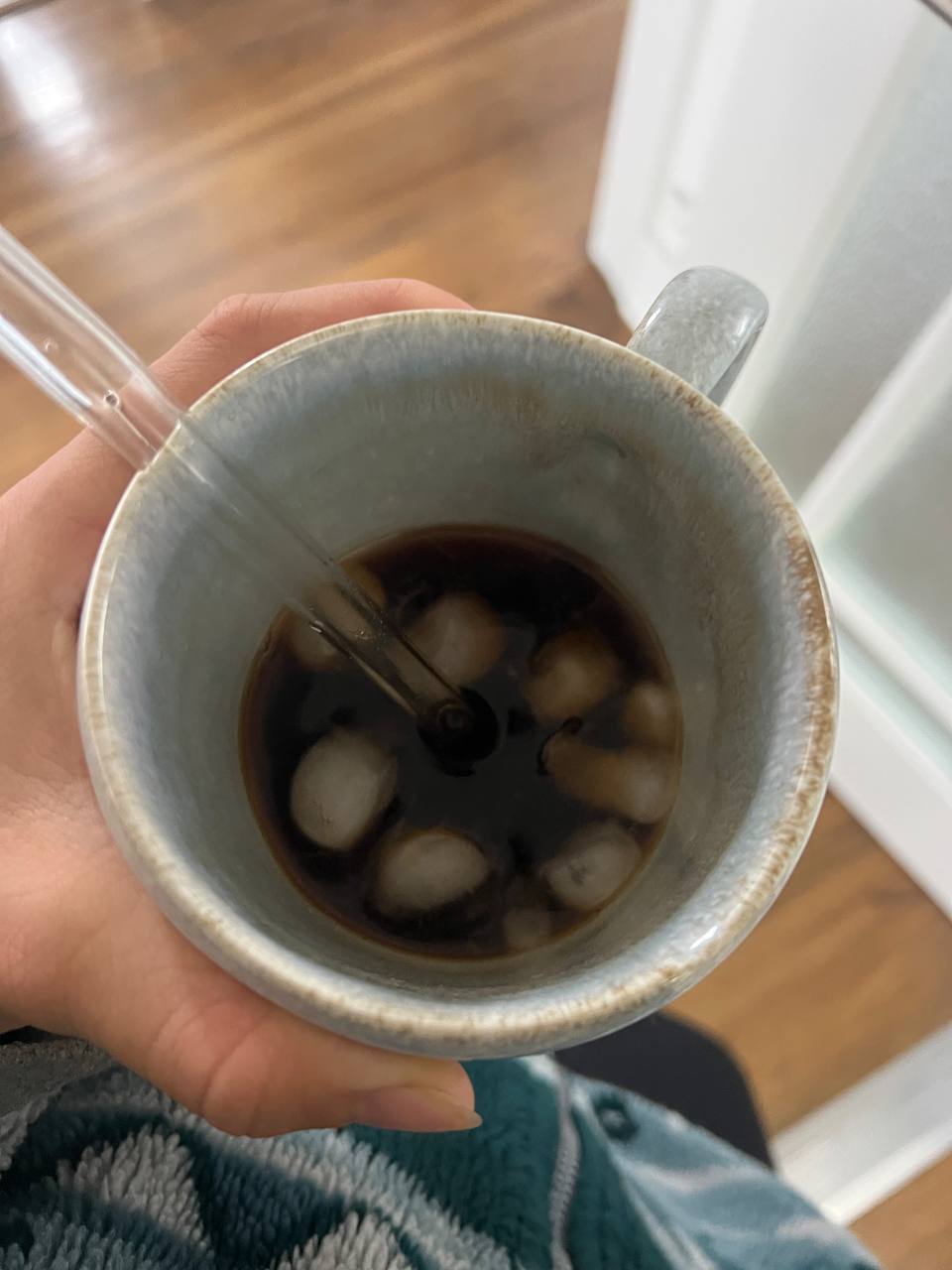
- Estimated intake: Energy 0-5 kcal; carbohydrate 0 g; protein 0 g; fat 0 g
- Key assumptions: Treated as plain black coffee only because neither the note nor image indicates caloric additions; Mug appears medium-sized, but exact poured coffee volume is uncertain and some of the visible volume is displaced by ice; Caffeine estimate is intentionally broad because iced coffee can vary substantially depending on brew concentration and whether it was brewed hot then cooled or prepared as a stronger concentrate; Intake is logged as the visible beverage only; no companion food is assumed
- Practical implication: This contributes caffeine and fluid but effectively no carbohydrate, protein, or meaningful energy; Fine as a low-calorie beverage, but it does not count as pre-session fuel or recovery nutrition on its own; If used before training, any performance benefit would come mainly from caffeine, so carbohydrate would still need to be covered separately when session demand is moderate to high; If this was consumed later in the day, total caffeine timing should be kept in mind so it does not interfere with sleep or subsequent recovery
- Status: complete
17:35
- Received: 2026-04-08 17:35 MDT
- Consumed: assumed 2026-04-08 17:35 MDT (athlete clarified this was after a 1.5 hr endurance ride; exact consumed time not separately stated, so receipt time is retained as the working assumption)
- Item: dates with peanut butter
- Source media path: /athlete/logs/media/2026-04-08/05-sidney-date-peanut-butter.jpg
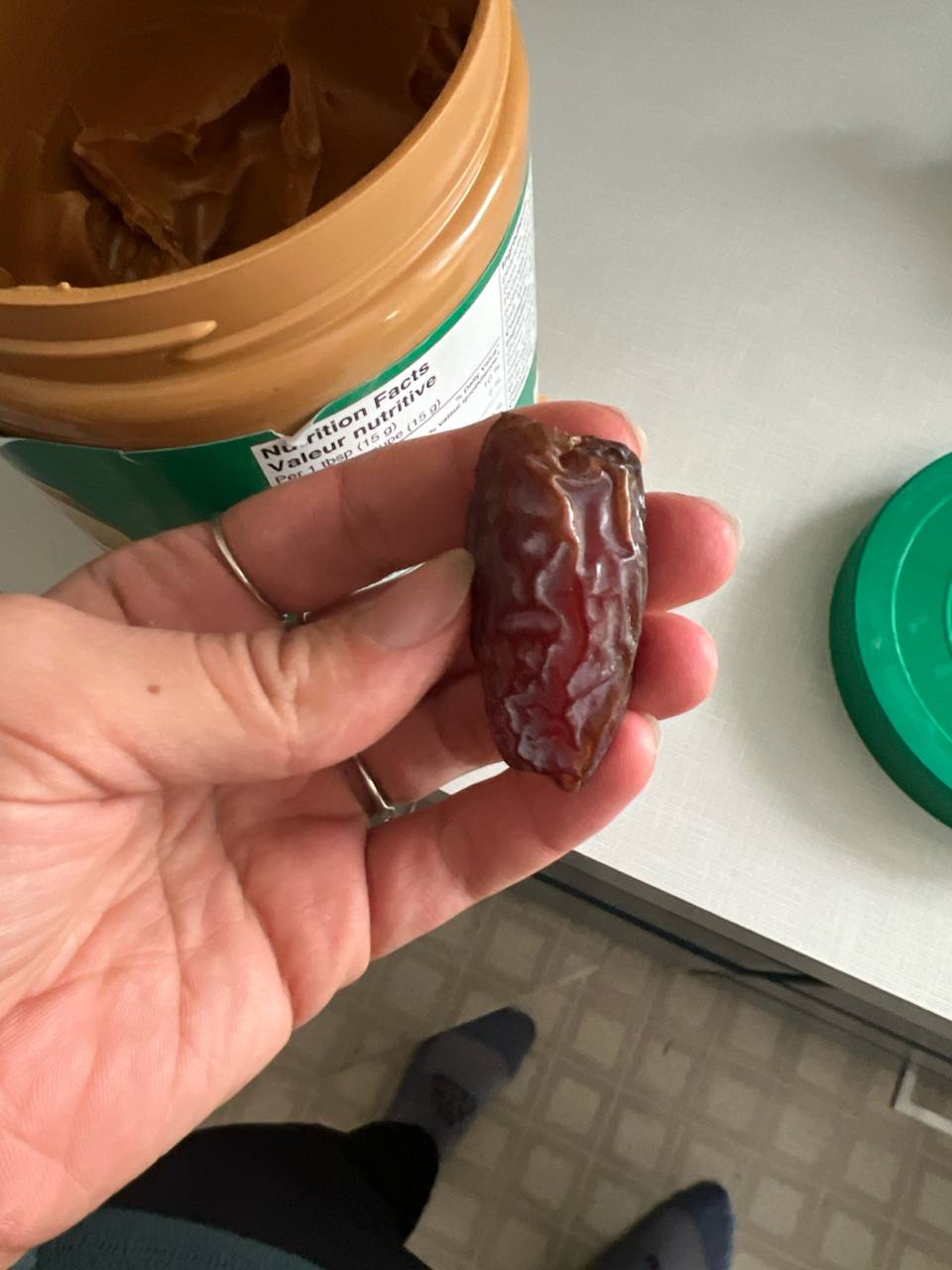
- Estimated intake: Energy 330-360 kcal; carbohydrate 66-72 g; protein 4-5 g; fat 8-9 g
- Key assumptions: Estimate is now anchored to the athlete-reported quantity rather than the image alone; Dates are treated as typical large Medjool-sized or similar, which drives most of the remaining uncertainty; Peanut butter is treated as a level tablespoon rather than a heaped serving; Apple is treated as roughly half of a medium apple with peel; No second serving, drink, or additional foods are included in the estimate; Endurance ride intensity is treated as steady aerobic work; exact ride intensity, during-ride fueling, and next-session timing were not provided
- Practical implication: After a 1.5 hr endurance ride, this now gives a slightly better carbohydrate top-up than previously estimated; The added half apple does not meaningfully change the overall recovery judgment because protein is still clearly too low to properly support muscle repair and fuller recovery; Peanut butter adds some energy but not enough protein to turn this into a complete post-ride recovery option; Practical takeaway: still inadequate as a standalone post-ride recovery feeding after 1.5 hr endurance work unless followed soon by a more complete meal or an added protein source
- Status: complete
19:33
- Received: 2026-04-08 19:33 MDT
- Consumed: assumed 2026-04-08 19:33 MDT (defaulted to receipt time; athlete identified this as dinner but did not state a different eating time)
- Item: bowl with hummus base, lentil-tomato-eggplant mixture, and grilled tofu cubes
- Source media path: /athlete/logs/media/2026-04-08/06-sidney-lentil-tofu-bowl-and-bread.jpg
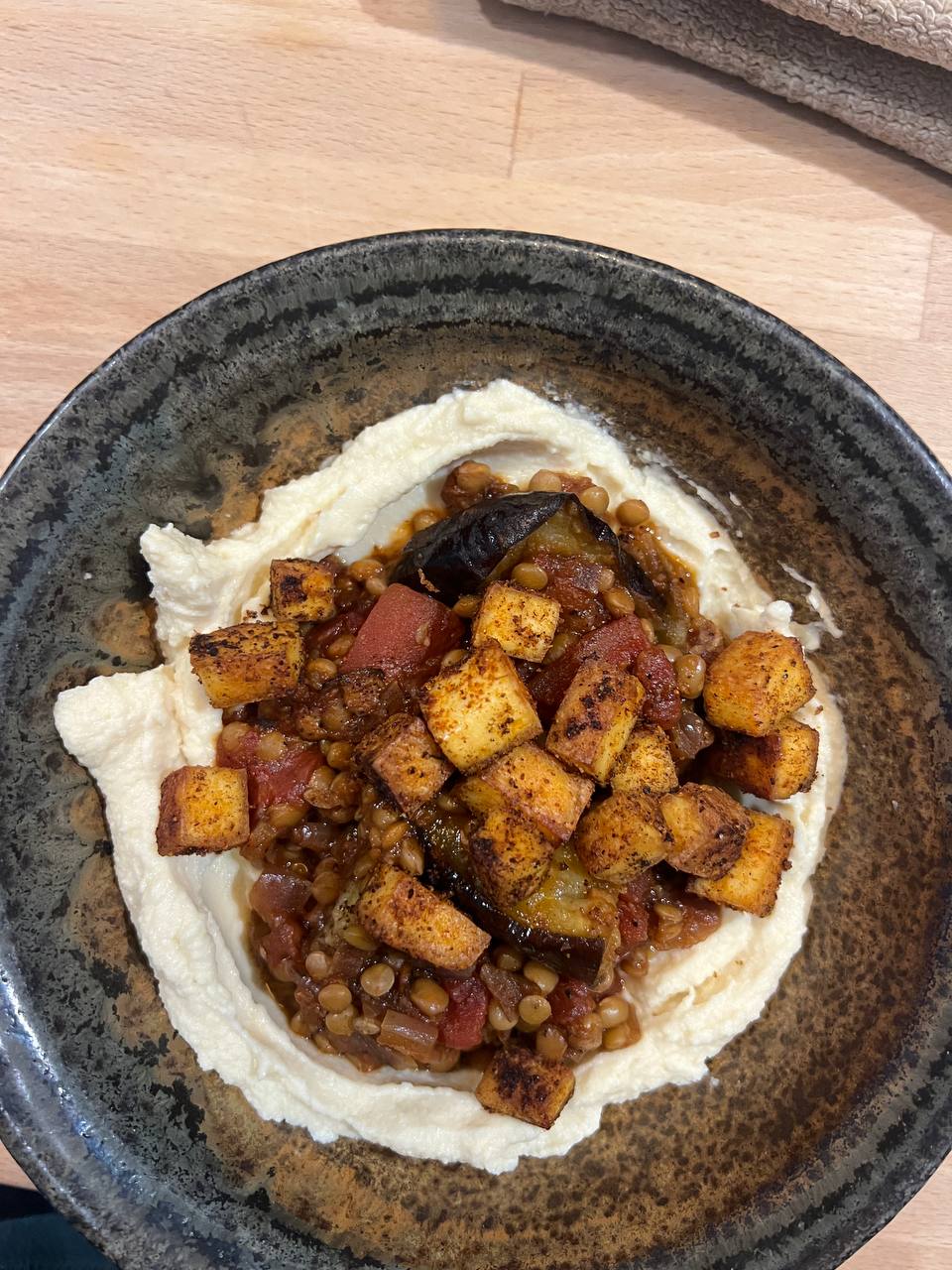
- Estimated intake: Energy 520-700 kcal; carbohydrate 65-90 g; protein 20-30 g; fat 14-24 g
- Key assumptions: Bowl estimate assumes roughly 3/4 to 1 cup cooked lentil-vegetable mixture over a substantial hummus base; Athlete clarification resolves the identity of the white base, but the overall estimate is not materially changed because hummus still fits within the original broad energy, carbohydrate, protein, and fat range already allowed for a bean- or tahini-based component; Added grilled tofu appears to be a small-to-moderate extra portion, roughly around 60-100 g cooked; Promise bread estimate uses the previously identified gluten-free loaf from the 2026-04-07 16:12 bread entry; 2 slices are treated as a meaningful but not oversized bread serving; No extra oil drizzle, butter on bread, or additional side dishes are assumed beyond what is visible and athlete-reported; Instagram recipe link did not yield usable ingredient text, so estimate remains intentionally approximate and image-led rather than recipe-precise, without relying on unrecoverable recipe text
- Practical implication: This looks like a more complete dinner than several earlier snacks today because it likely supplies a useful mix of carbohydrate, plant protein, and total energy; The 2 slices of bread materially improve carbohydrate coverage, which is helpful if this followed afternoon training and the earlier post-ride snack was protein-light; Protein is probably adequate for a normal evening meal if the tofu and hummus were both fully eaten, but the meal still sits closer to moderate than high protein rather than especially protein-dense; Fiber load may be fairly high from lentils, vegetables, and seeded gluten-free bread, which is generally fine at dinner but could be worth noting if gut comfort has been an issue around late eating or next-morning training
- Status: complete
Messages
Morning plan
- No morning plan artifact consolidated for this date.
Evening summary
- No evening summary artifact consolidated for this date.
Same-day inbound highlights
- No additional non-nutrition inbound highlights were consolidated for this date.
System
- Nutrition workflow items routed: 5
Notes
- Legacy sources used for this consolidation:
- athlete/team/endurance/logs/daily/2026-04-08.md
- athlete/team/recovery/logs/daily/2026-04-08.md
- athlete/team/strength/logs/daily/2026-04-08.md
- athlete/team/nutrition/logs/daily/2026-04-08.md
Open items
- No open items consolidated for this date.